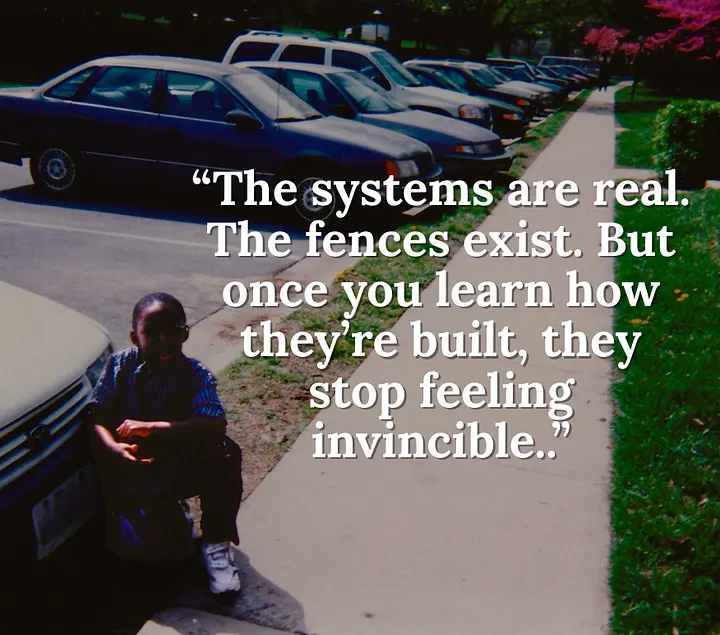
Fences Feel Invincible Until They Don’t
By Isaac Cudjoe, CEO at Peace First
Lately, when I ask people what made them push through and persevere, I keep hearing a similar answer. Instead of naming a voice of hope, they point to a voice of doubt. A teacher, a coach, a parent, someone who said the wrong thing at the wrong time, and ended up becoming motivation to prove them wrong.
When I look back on my own life, that isn’t what stands out. Don’t get me wrong, there were adults who mistook harshness for discipline. Things were said. Assumptions were made. But that isn’t what shaped me most.
When I was in fifth grade, I had a friend named Daniel. His family had immigrated from Peru, and mine from Ghana. We lived in Gaithersburg, Maryland, and one afternoon, after walking to the Wendy’s on Lost Knife Road, we ended up in the open field that sat between our two neighborhoods.
Daniel lived in the Cider Mill Apartments. I lived in the Horizon Run townhome neighborhood. The field was the halfway point, where you stopped before heading back in opposite directions.
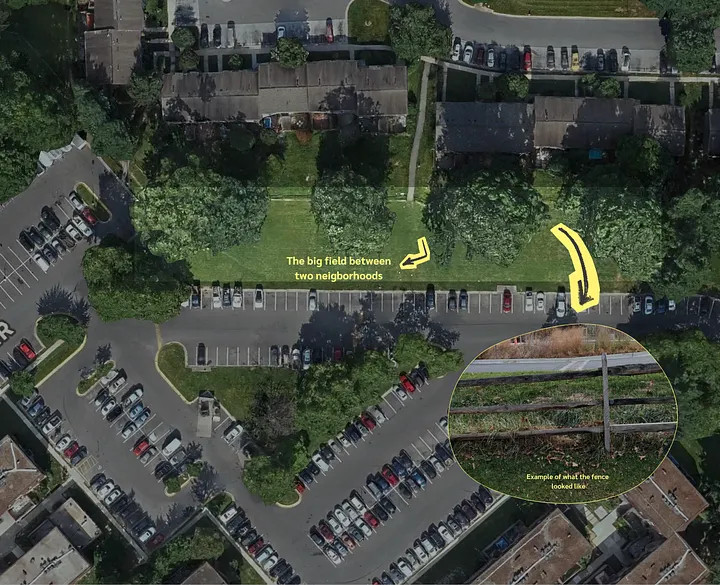
There was a fence, but only on one side of the field, a thin, old wooden fence along the edge of the townhomes. It wasn’t tall, and it wasn’t hard to cross, but it was there. It always felt symbolic, like someone thought a line needed to exist between two neighborhoods on the same road, even though whatever moved through one could just as easily move through the other.
Before we went our separate ways, we had to pull our food out of the shared Wendy’s bag we were carrying. He ended up facing my neighborhood while I faced his, and for a moment, neither of us said much. We were unwrapping our food, digging for fries, letting the quiet stretch the way it does when there’s no rush to fill it.
It almost felt like we knew what the other was thinking. We started talking about our parents, how hard they worked, the long hours, sometimes more than one job, and there was a kind of pride in the way we talked about them, the kind kids have when they know their parents are doing their best.
At the same time, we also knew that our parents’ lives weren’t the norm for everyone. We saw it at school, in the way some kids dressed, the lunches they brought, and how easily they talked about things we learned to think through more carefully.
So we came up with a theory. I think of it now as the Daniel and Isaac theory of wealth management, two ten-year-olds trying to make sense of a world we didn’t yet understand.
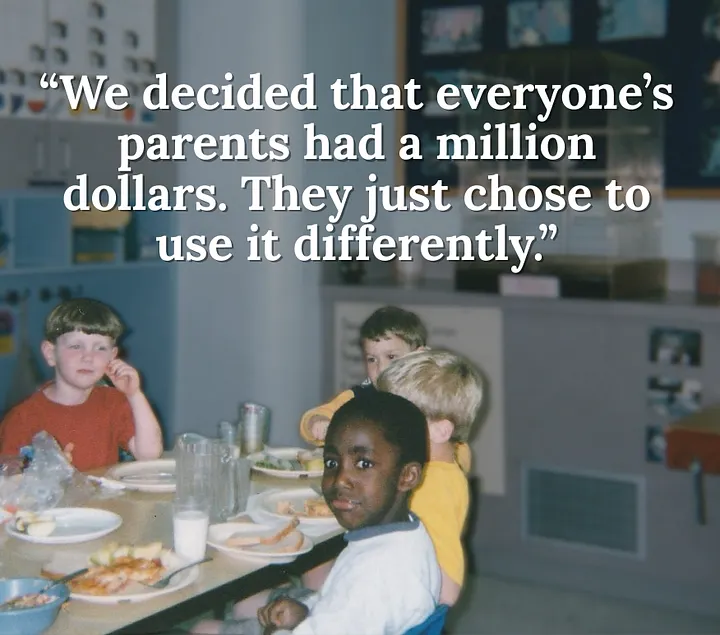
Our parents didn’t need big hallways or extra bedrooms. They didn’t care about nice cars or designer shoes. They were choosing a simpler life. Because nobody works that hard not to get what they want, right?
That explanation made sense to us. It had to. It protected our parents, and it protected us from noticing how early the world starts sorting people, not by how hard they work, but by how much room they’re given to move.
For a while, it made everything make sense.
But as I got older, that explanation got harder to hold onto. It didn’t matter where I was or how far I was from that field. Permission slips for field trips were exciting until there was a cost attached. After-school programs sounded great, but they were always met with a pause before a yes, a maybe, or a not right now.
What stayed with me wasn’t that my parents couldn’t afford these things. It was the hesitation I could feel. The way talk of money subtly changed the temperature of the room. I could sense the calculation happening without anyone ever naming it.
Slowly, I started to understand that wanting something and reaching for it were not the same thing, that our parents weren’t choosing less. They were carrying more, with less room to set it down.
That realization still shapes how I listen to these conversations now. When people talk about what discouraged them, they often point to a person, a teacher, a coach, someone who said something that lingered. And I get that. Those moments matter.
But people are also products of systems built by other people.
I started paying closer attention to how systems and institutions actually moved, how they could present themselves as polite and well-intentioned and still be deeply indifferent. How they could talk about fairness and opportunity while quietly making it clear, over time, that effort alone wouldn’t guarantee access. It began to feel like grit and tenacity were just words the system spoon-fed people it never intended to let anywhere near the buffet of opportunities in the first place.
Here’s the truth. We all have the same twenty-four hours, but we don’t have the same room to use them. We don’t have the same margin for error. We don’t have the same safety when something goes wrong.
Realizing that does make you heavier. Hopefully not bitter or defeated, but aware in a way that sharpens your attention. Because it also leaves you with a choice, whether you accept that logic as fixed, or whether you start paying closer attention to how it actually works.
By the time I got to college, I had accumulated enough evidence to know that a lot of these limits weren’t just structural. They were psychological, and if I wasn’t careful, they could become internalized in ways that were hard to undo. But if limitation could settle in like that, I started to wonder whether resilience could too.
I began picking apart the ways my parents worked, the persistence they showed even when things were uneven. I started to assume that some of that lived in me as well, that if they could keep figuring things out, I could too.
So when I couldn’t afford my textbooks, I built a network of friends with earlier classes who would lend me theirs. I borrowed notes and read ahead. When graduate school felt financially out of reach, I took a year off and sat in the public library, learning everything I could about funding and scholarships, trying to understand how decisions were actually made. I even made peace with a two-and-a-half-hour commute to get to work, trusting that it was part of something larger.
Every time I ran into a door that said no, I tried to understand who put the sign there, what it was protecting, and whether the door was actually locked or just testing who would turn the handle.